Fed-batch in a microtiter plate – the easy way

1
2
3

Release of nutrients
1

The inert silicone matrix contains the nutrient

2

The liquid medium comes into contact with the silicone matrix

3

Nutrient is continuously released and allows controlled feeding. The silicone matrix remains stable and preserved.

Our technology makes it easy to implement a fed-batch screening in microtiter plates (MTP). It is based on a silicone matrix in which nutrients are embedded. Getting in contact with a liquid, a continuous release of nutrients into the medium starts. This allows a controlled feeding of the culture. The products of the Feeding technology are delivered sterile and can be easily used with standard laboratory equipment.
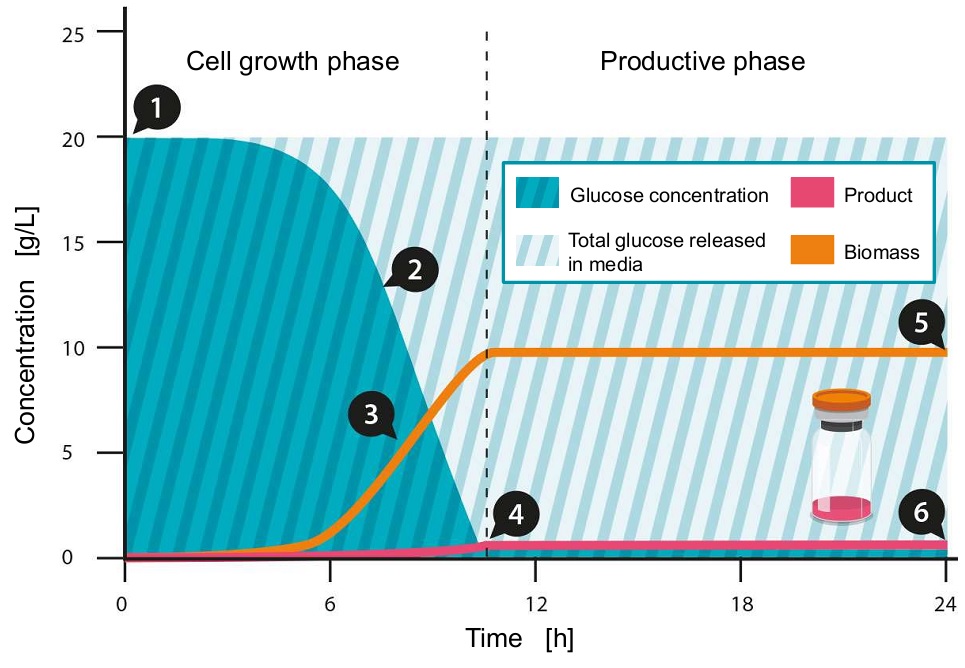
Comparison of a catabolite-repressed strain in a batch and  fed-batch cultivation

1
2
3
4
5
6
1

Complete amount of glucose is present at the beginning

In the classic batch screening, the complete amount of glucose is presented in the medium. The concentration of glucose in the solution decreases continuously.

2

Glucose excess

Due to the excess of glucose, the cells multiply exponentially without forming the desired product. Product formation is suppressed during this time (catabolite-repression). The risk of oxygen limitation as well as the formation of undesirable by-products is high.

3

Glucose excess

Due to the excess glucose, the cells multiply exponentially without forming the desired product. Product formation is suppressed during this time (catabolite-repression). The risk of oxygen limitation as well as the formation of undesirable by-products is high.

4

Short production phase

Only when the glucose is almost exhausted, the product formation begins. The cells are not catabolite repressed anymore. The remaining glucose is so low that the product formation comes to a standstill after a short time.

5

High biomass concentration, but a low yield

At the end of the batch cultivation mainly biomass was formed, the product yield is low.

6

High biomass concentration, but a low yield

At the end of the batch cultivation mainly biomass was formed, the product yield is low.

1
2
3
4
5
1

Continuous release of glucose

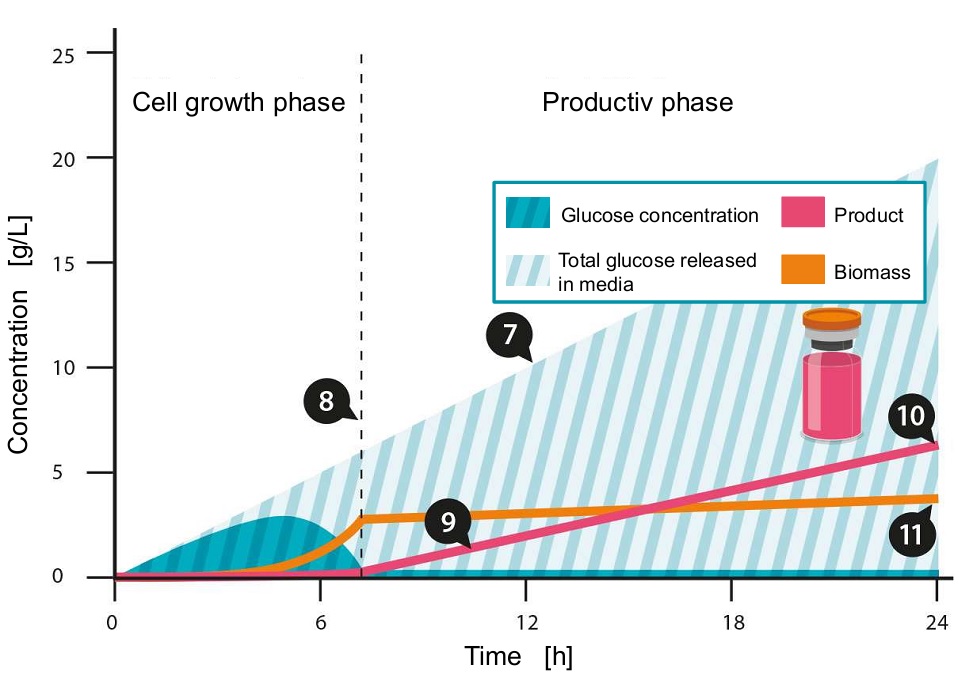
The Kuhner Feeding technology continuously releases glucose in the medium during your screening. The conditions are thus more comparable to the later production process. This allows an optimal strain selection.

2

The production phase is reached faster

In the cell growth phase, the released glucose accumulates briefly in the medium. The cells grow exponentially and form biomass until the accumulated glucose is consumed. The subsequent production phase has been reached quickly.

3

Continuous product formation

The glucose concentration in the medium is almost zero, as the released glucose is immediately metabolized. The cells are thus not catabolite-repressed and product is continuously formed. The conversion of glucose into product is as efficient as possible.

4

Optimum product yields

Due to the long production phase, significantly more product is formed with lower biomass concentration. The product yield is high and comparable to the later production process.

5

Optimum product yields

Due to the long production phase, significantly more product is formed with lower biomass concentration. The product yield is high and comparable to the later production process.